
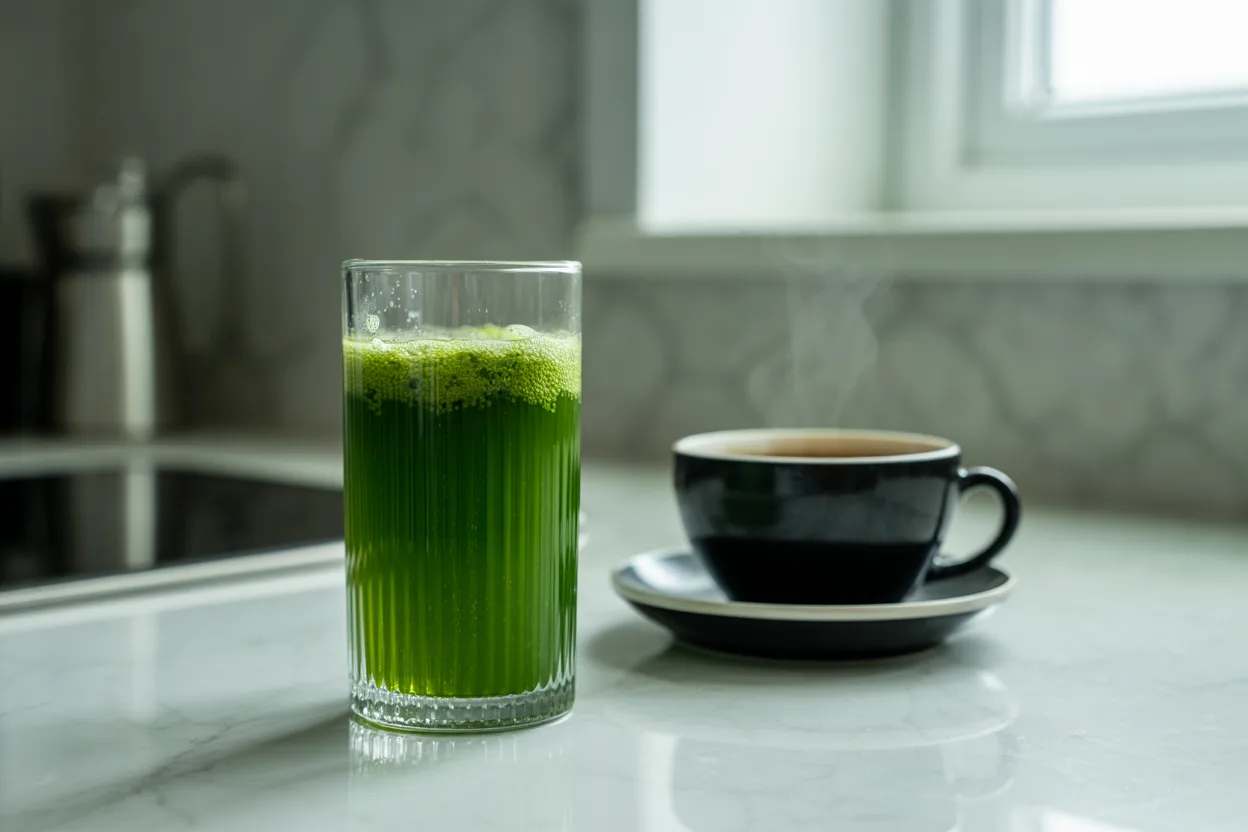


Celery juice breaks an intermittent fast. It contains 30–70 calories and 6–12 grams of carbohydrates per 16 oz serving — enough to stimulate insulin, pause fat oxidation, and interrupt digestive rest. It is nutritious, but it is not metabolically neutral. Drink it inside your eating window, not during the fast.
Celery juice has a reputation that makes it feel untouchable. Supposed to be good for your liver, your skin, your gut. It doesn’t feel like food. It feels like a health habit. A ritual. Something that belongs in the “doing good things for my body” category.
So, if it’s just vegetables, mostly water, barely any calories… does it actually interfere with a fast?
The honest answer isn’t dramatic, but it is specific. Celery juice isn’t metabolically invisible. Whether that matters depends entirely on what outcome you’re aiming for.
This isn’t about labeling it good or bad. It’s about understanding what happens in your body when you drink it—and deciding, on purpose, whether that fits the kind of fast you’re trying to keep.
Step 1: What Counts as “Breaking a Fast”?
Before answering the celery question, we need to define what “breaking a fast” actually means.
There are two common fasting lenses.
1) Clean/physiological fast
Goal: minimal digestive activity and minimal insulin stimulation. This approach is often used for metabolic flexibility, autophagy exploration, or digestive rest.
2) Goal-based fast (fat loss/appetite control)
Goal: reduce total intake, simplify eating, and create structure that’s easy to repeat.
From a strict physiological standpoint, any intake containing carbohydrates, protein, or meaningful calories activates digestion and influences insulin signaling.
Does celery juice break your fast?
The answer depends on why you are fasting. Answer 3 questions and get a verdict specific to your goal.
Even small carbohydrate doses can stimulate insulin secretion depending on context and individual response. Research examining metabolic responses during fasting states shows that carbohydrate ingestion shifts insulin and substrate utilization patterns relatively quickly.
Celery juice contains carbohydrates.
That matters.
Step 2: Celery Juice Calories and Carbs
Whole celery is extremely low in calories. That’s part of its reputation.
But juice is not the same thing as chewing a stalk.
A typical 16 oz (475 mL) serving of celery juice can contain roughly:
- 30–70 calories
- 6–12 grams of carbohydrates
That doesn’t sound like much. And nutritionally, it’s not dramatic.
What is actually in celery juice vs. fast-safe drinks?
Adjust the serving size and see exactly what you are consuming — and why the comparison to black coffee matters.
Celery juice values are estimates based on a standard 16 oz serving. Exact values vary by celery variety, juicer type, and preparation. Nutritional data sourced from USDA FoodData Central.
The issue isn’t whether celery juice is healthy. The issue is that liquid carbohydrates behave differently from solid foods.
Liquid carbs are absorbed more rapidly and can stimulate a quicker glycemic and insulin response compared to intact fiber-containing foods. When you juice celery, much of the fiber matrix that slows digestion is reduced.
What’s left is water plus rapidly available carbohydrates.
That is not the same as black coffee.
From a clean fasting perspective, that breaks the fast.
Step 3: Insulin, Fat Burning, and Why Juice Is Different
One of the physiological shifts during fasting is a reduction in insulin levels. As insulin drops, the body increases lipolysis — the breakdown of stored fat — and shifts toward fat oxidation.
Even modest carbohydrate intake interrupts that shift temporarily.
Research consistently demonstrates that carbohydrate ingestion increases insulin and suppresses lipolysis. While that particular study examined sucralose effects in certain contexts, the broader physiological principle holds: carbohydrate presence influences insulin signaling.
Celery juice is not soda. But it still contains glucose and plant-derived carbohydrates.
If you’re fasting for:
- Fat loss → celery juice pauses fat oxidation during that period.
- Metabolic flexibility → it interrupts the fasted state.
- Autophagy or cellular cleanup experiments → caloric intake disrupts fasting physiology.
- Appetite control → a sweet or caloric beverage may stimulate hunger for some people.
It’s not catastrophic. It’s simply not a fasted state anymore.
Step 4: The Gut Rest Question (Migrating Motor Complex)
There’s another piece most people don’t talk about: digestive rest.
During fasting periods, the body activates the migrating motor complex (MMC)—a cyclical wave of electrical activity that helps clear residual food and bacteria from the small intestine.
This “housekeeping wave” occurs between meals, typically in fasted states.
Food intake interrupts MMC activity. Even small caloric beverages stimulate digestive processes and pause this cycle.
If someone is fasting for digestive reset, bloating relief, or gut motility support, celery juice ends that rest period.
Again, not dangerous. Just not neutral.
Step 5: “But It’s Healthy…”
Celery juice isn’t junk. It contains antioxidants, flavonoids, and phytonutrients. Reviews of celery’s phytochemical profile show potential anti-inflammatory and antioxidant compounds.
It can absolutely be part of a healthy dietary pattern. The mistake is assuming that “healthy” automatically equals “fast-friendly.”
Water is fast-friendly. Black coffee is fast-friendly. Plain tea is fast-friendly.
Celery juice is a food. A nutritious one. But still food.
The clock doesn’t care whether calories come from donuts or celery.
Step 6: What If You’re Only Fasting for Weight Loss?
If you’re running a goal-based fast and your primary objective is fat loss, the impact becomes practical rather than philosophical.
Thirty to seventy calories won’t ruin your day. But here’s the pattern to watch:
- Liquid calories are easy to underestimate.
- They don’t create strong satiety.
- They can lead to “it’s basically nothing” thinking.
If celery juice at hour 14 leads to hunger at hour 15 and a larger eating window later, it’s not helping.
If it becomes a ritual that keeps you consistent and replaces something higher calorie, it might not be a huge issue — but it’s still technically breaking the fast.
If your fasting rule is “no calories until noon,” celery juice doesn’t fit.
If your rule is “keep total daily intake controlled,” it becomes a personal trade-off.
Step 7: When Should You Drink Celery Juice?
The answer is simple. Drink it:
- Inside your eating window
- As part of a meal
- Or immediately when you break your fast
That preserves the integrity of your fasting window while keeping the health benefits. There’s no need to give it up entirely. Just move it to the right side of the clock.
Common Objection: “But It’s Only 30 Calories”
Yes. And physiology doesn’t operate on marketing language.
Thirty calories of carbohydrates are still carbohydrates. They stimulate digestion and insulin. They even shift substrate use.
Fasting is all about your metabolic state. If you want the metabolic state of fasting, stick to non-caloric beverages. If you want celery juice, enjoy it. Just not during the fast.
The Bottom Line
If your fast allows:
- Water
- Black coffee
- Plain tea
Then celery juice doesn’t qualify.
It contains calories and carbohydrates, so it stimulates digestion and insulin.
Healthy? Yes.
Fast-friendly? No.
There’s nothing wrong with celery juice. It just belongs in your eating window.
Experiment with Municorn’s Fasting App
If you’re unsure whether something fits your fasting window, don’t guess.
Use the Fasting App to track your fasting hours, log beverages, and see how different choices affect hunger, energy, and consistency in your real life.
Keep the green juice. Just move it to the right side of the clock.
Is celery juice the same as eating celery during a fast?
No. Whole celery is mostly fiber and water — chewing it slows digestion and blunts the glycemic response. Juicing strips most of that fiber out, leaving rapidly absorbed carbohydrates that behave more like a liquid sugar hit than a vegetable.
Does celery juice affect autophagy?
Yes. Autophagy requires your body to stay in a low-insulin, low-nutrient state for long enough to activate — research suggests signals begin around 17 hours and deepen past 24. Any caloric intake, including celery juice, raises insulin and resets that clock. If autophagy is your reason for fasting, only water, black coffee, and plain tea qualify during the window.
What about celery juice on an empty stomach — is that different?
It is actually worse from a fasting standpoint. On an empty stomach, there is nothing to buffer absorption. The carbohydrates enter the bloodstream faster, the insulin response is sharper, and the fasted state ends more abruptly than it would mid-meal.
Does green juice in general break a fast?
Yes, any cold-pressed or blended juice containing fruits or vegetables will break a fast. The calorie and carbohydrate content varies by ingredient, but none qualify as fast-safe under a clean fasting protocol.
Is celery juice keto friendly?
In moderate amounts it can fit a ketogenic diet — the carb count is low enough for most people's daily limits. But that is a separate question from fasting. Keto-compatible does not mean fast-compatible.