
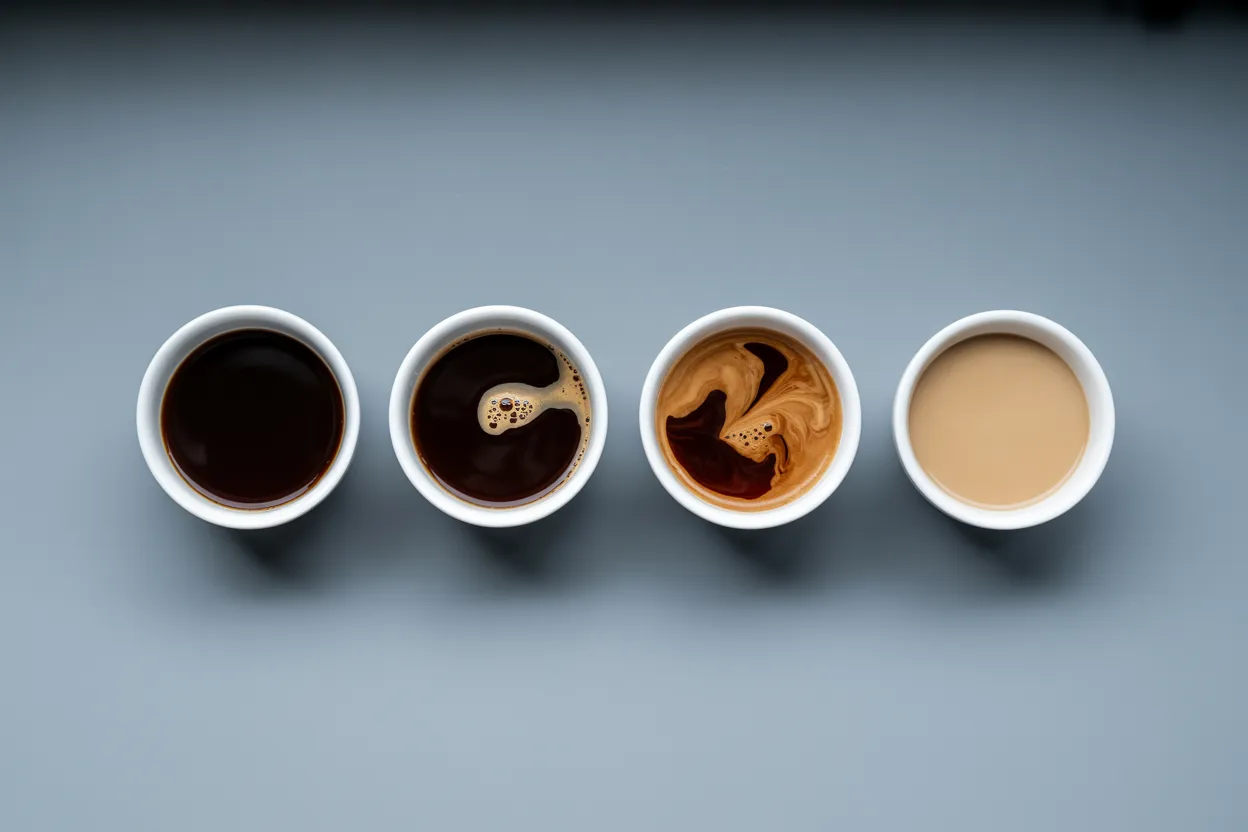
Coffee is the lifeline. Black coffee is the punishment.
You’ve done the hard part. You didn’t snack. You didn’t graze. You drank your water. And now you’re staring at a mug that feels more like a test of character than a beverage.
Creamers and sweeteners feel small. Harmless. A splash. A packet. A “zero-calorie coffee creamer” that technically doesn’t count.
And yet this is where a clean fast quietly turns into a fuzzy one.
This isn’t a purity lecture. You don’t need fasting perfection. You need a decision system that keeps your fast effective without making your mornings miserable.
Let’s build that.
Step 1: Decide What Kind of Fast You’re Running
Most fasting confusion happens because people mix up goals.
There are two lanes.
Lane A: Clean Fast (Strict Physiology)
This is the minimalist lane. If it has calories, sweetness, or flavor beyond coffee or tea, it’s out. The goal is minimal metabolic stimulation. Black coffee. Plain tea. Water. Done.
If you’re experimenting with gut rest, autophagy-focused protocols, or you simply prefer clean rules, this is your lane.
Lane B: Goal-Based Fast (Fat Loss + Adherence)
This is where most people actually live. You’re fasting to reduce calorie intake, simplify mornings, and improve consistency.
A small add-in that helps you stick to the plan may be worth it. If it doesn’t trigger more hunger later.
A randomized trial on time-restricted eating found that simply shrinking the eating window didn’t outperform a control schedule for weight loss when overall intake didn’t change. Translation: structure helps, but behavior decides.
If your coffee add-ins make you snacky at 10 a.m., they’re not helping your fast. They’re feeding the loop.
Step 2: The 50-Calorie Ceiling
Here’s the anchor: keep fasting add-ins at 50 calories or less total.
Not per splash. Per mug.
Because “I barely use any” is usually a serving-size illusion.
Heavy cream is usually about 50 calories per tablespoon. Two generous pours and you’re over 100 calories before noon. Without ever feeling like you ate.
Even “zero-calorie” products deserve attention. Non-nutritive sweeteners don’t provide meaningful energy, but research shows mixed metabolic responses depending on context and individual differences. A systematic review on non-nutritive sweeteners and glucose regulation found heterogeneous effects across studies.
So the rule isn’t fear. It’s awareness.
Small things add up. Especially when you have three coffees.
Step 3: Creamer Tiers—What Actually Happens
Coffee Creamer & Sweetener
Survival Guide
The 4-tier creamer chart and sweetener craving-risk ladder — so you can make a call in 30 seconds.
The anchor rule: keep all add-ins at 50 calories or less per mug — not per splash. “I barely use any” is usually a serving-size illusion. Heavy cream is ~50 cal per tablespoon. Two pours = 100+ before noon.
Run the 3-day coffee audit. Don’t change your window or calories. Just track: number of coffees, exact add-ins + calories, hunger at hour 16, cravings at night. Patterns tell you more than rules.
Track with Municorn ↗Tier 1: Safest for a Clean Fast
Black coffee. Plain tea. Water.
That’s your baseline.
Caffeine itself can acutely affect insulin sensitivity, but black coffee remains metabolically minimal compared to caloric add-ins.
Tier 2: Best Compromise for Goal-Based Fasting
Unsweetened almond milk.
Low calorie. Low carb. Easy to measure.
So let’s answer it directly:
Does almond milk break a fast?
Technically, yes. If you define fasting as zero calories.
Practically, a measured splash (15–30 calories) often keeps a fat-loss-focused fast intact because total intake across the day still determines outcomes.
If that splash helps you avoid a 10 a.m. pastry, it’s doing its job. The problem isn’t almond milk. It’s when you start pouring freely.
Tier 3: Heavy Cream—Fasting-Friendly Vibes, Calorie-Dense Reality
Heavy cream is low in carbs, which is why it gets labeled “fasting safe” in low-carb circles.
But it’s calorie dense.
One generous pour can quietly exceed 100 calories. Two mugs and you’re approaching a small meal.
Fat doesn’t spike insulin dramatically, but it absolutely counts toward energy intake. And fasting doesn’t cancel physics.
If you’re using heavy cream, measure it. Don’t eyeball it.
Tier 4: Zero Calorie Coffee Creamer
The marketing says zero. The ingredient list says emulsifiers, oils, flavors, and sometimes sweeteners.
From a calorie standpoint, many truly contain negligible energy. From a behavior standpoint, sweetness can still influence appetite and cravings for some people.
A review on the biological fate of low-calorie sweeteners highlights that while they provide little to no energy, their metabolic effects vary by compound and context.
If you use a zero calorie coffee creamer:
- Measure it.
- Keep it occasional.
- Pay attention to whether it makes you hungrier later.
Your body gives feedback. Listen to it.
Step 4: Sweeteners—The Craving Risk Ladder
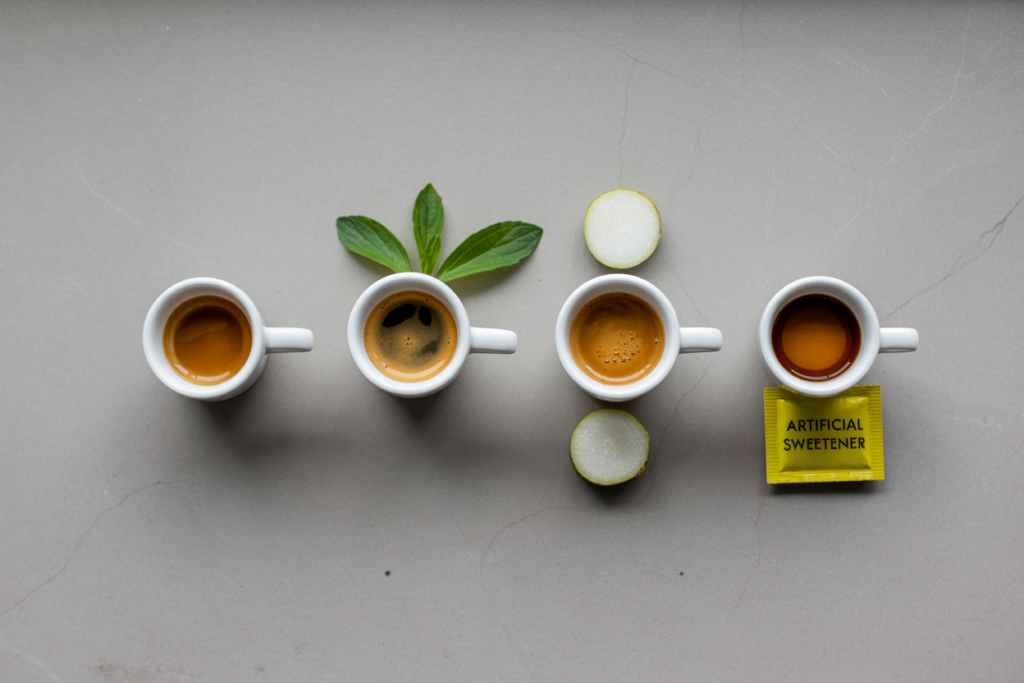
Stevia Intermittent Fasting
If you’re going to experiment, stevia is often the lowest-drama place to start.
When people search “stevia intermittent fasting,” they’re really asking whether sweetness alone derails a fast.
Stevia provides negligible calories, and evidence on its glucose and insulin effects in humans is mixed but generally modest at typical intakes.
Still, treat it as personal tolerance, not a universal free pass. If sweet coffee makes you want sweet food, that matters more than lab values.
Monk Fruit
Monk fruit extracts (mogrosides) are also low or zero calorie. The catch? Many products blend monk fruit with erythritol or other sweeteners.
Read the label.
Choose simple ingredient lists. And again, measure.
Sucralose & Artificial Sweeteners
This is where individual variability becomes obvious.
One study found that sucralose altered insulin and glucose responses in obese individuals not accustomed to artificial sweeteners.
Another line of research suggests certain artificial sweeteners may alter gut microbiota in ways that influence glucose tolerance in some contexts.
This doesn’t mean “never.” It means pay attention. If sucralose-sweetened coffee makes you hungrier or cravings spike at night, that’s useful data.
Step 5: The 3-Day Coffee Audit
Don’t change your fasting window. Don’t tighten your calories. Don’t overhaul your diet.
For three days, track:
- Number of coffees
- Exact add-ins + calories
- Hunger at hour 16
- Cravings at night
If adherence improves when coffee is cleaner, you found your bottleneck. If nothing changes, you’ve ruled it out. That’s how you can troubleshoot.
The Bottom Line
Fasting doesn’t require suffering. If you want the cleanest fast possible, keep it black.
If you’re running a goal-based fast, stay under the 50-calorie ceiling, measure what you pour, and treat sweetness as a behavioral variable. Not just a calorie one.
The clock sets the window. Your inputs still decide the outcome. Coffee should help your fast work. Not quietly undo it. Use the Municorn Fasting App to track how coffee creamers affect your fast.