
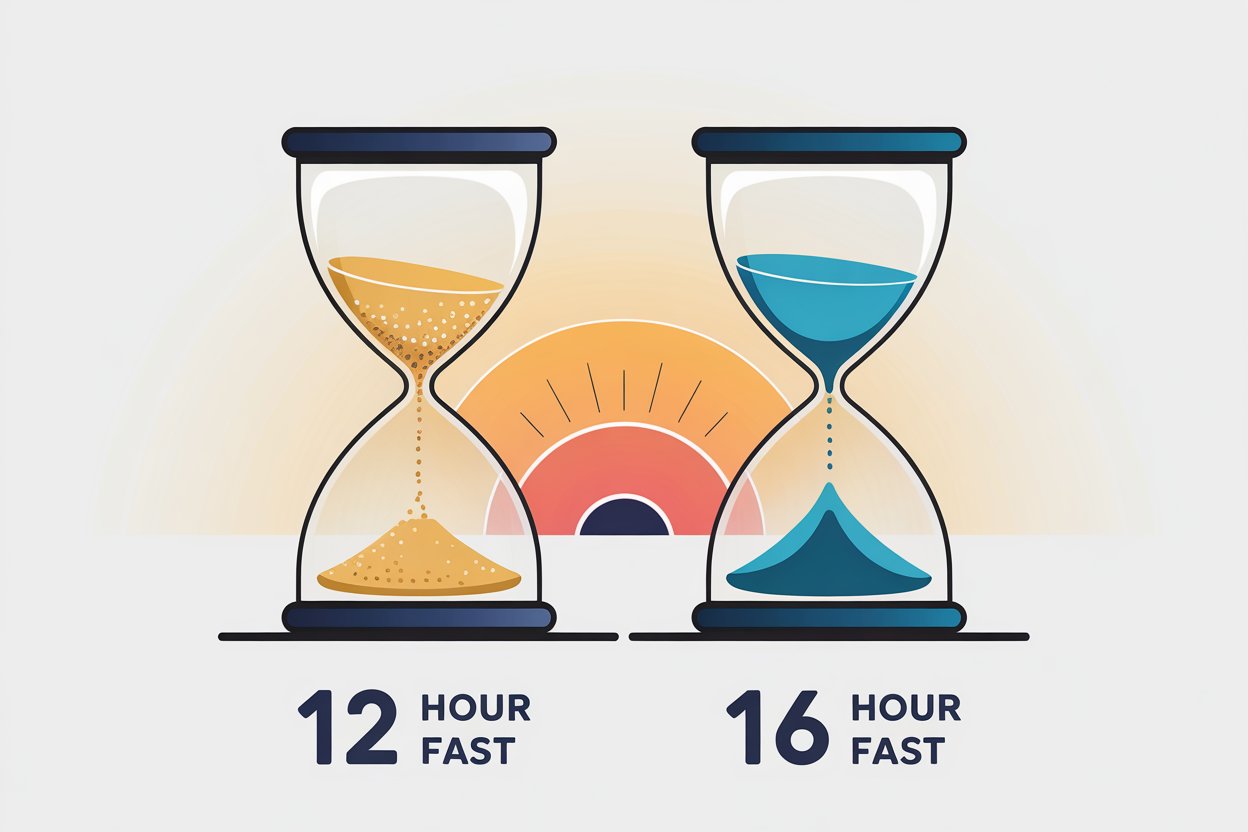

From time-restricted eating to alternate day fasting, there are many different types of intermittent fasting schedules to choose from. So, how do you know which one is better for your overall health? Is it more like choosing between cats and dogs (in theory, a choice between two equally great options) or a success and a catch-22?
To answer those questions, let’s take two of the most popular fasting schedules—12:12 intermittent fasting and 16:8 intermittent fasting—and place them in a fasting practice face off.
Here’s everything you need to know about a 12-hour fast vs. 16-hour fast.
(Spoiler alert: It’s less about a boxing match between two intermittent fasting diets and more about which one is a good match for you and your goals!)
Whether you’re considering trying intermittent fasting for the first time or you’re looking to switch up your schedule, you should always discuss any changes to your lifestyle or eating habits with your primary care provider before you make them. You should be particularly cautious about any form of intermittent fasting if you:
- are pregnant, breastfeeding, or trying to conceive;
- are under 18 or over 80 years;
- have a BMI in the “underweight” category;
- have a history of, or are at risk for, disordered eating;
- are under a lot of stress;
- have nutritional deficiencies;
- have an existing medical condition (like diabetes or insulin sensitivity); or
- take certain medications that affect blood sugar or blood pressure or need to be taken with food.
What Is 12:12 Intermittent Fasting?
12-hour intermittent fasting involves splitting your day in two: a 12-hour fasting window and a 12-hour eating window. That means that for 12 hours of every day—most of which overlap with your natural daily fast during sleeping hours—you take a break from consuming calories. Water is still very much on the table (and highly necessary for safety), and so are moderate amounts of other low-to-no-calorie beverages like unsweetened tea, black coffee, and diet soda (just watch out for caffeine and artificial sweeteners).
Whenever that fasting period occurs is totally up to you. If you like to eat breakfast as soon as you get up at 7 a.m., plan to finish dinner by 7 p.m. the previous evening. If you get home late and don’t finish eating until 11 p.m., just skip breakfast the next morning or have brunch after 11 a.m.
What you eat and drink during this eating routine is also completely in your control: Beyond the number of hours you fast, there are no hard-and-fast rules for this eating plan. (Yes, you may want to prioritize more health-promoting and nutrient-dense foods to maximize your results, but nothing is off the table.)
What Is 16:8 Intermittent Fasting?
16-hour intermittent fasting follows all the same principles as 12:12 fasting, but your fasting period is a few hours longer (four, to be exact). So, you eat all your meals during an 8-hour period and then fast for the remaining 16 hours of the day.
As with 12:12 fasting, a big chunk of those fasting hours are taken up by sleeping, but this eating routine might require just a touch more rejigging of your normal routine. You don’t necessarily have to skip breakfast or dinner, though—you can just eat earlier or later accordingly.
What Happens After 12 Hours and 16 Hours Without Eating?
When you finish a meal, your body starts digesting, distributing, and absorbing what you just consumed. Insulin—a hormone that ferries nutrients to where they need to go—acts as the ringleader in that process.
Over the next few hours, that meal gets transformed into helpful body stuff, like fat, muscle, energy, and brain power. Your body then transitions into a post-absorptive state—the internal equivalent of a food-coma snooze—for roughly 8–12 hours before your insulin levels drop and you enter ketosis, a metabolic state where your body starts to burn fat stores for fuel.
So, after 12 hours without eating, there is a chance you’ll hit ketosis, but considering those first couple of hours post-meal that your body needs to transform nutrients, it’s not guaranteed. It’s not guaranteed after 16 hours without eating, either—bodies go through this digestion process at different speeds, and there’s not an exact science for determining how long your body needs to flip that metabolic switch (especially because some other biological and lifestyle factors can affect things, too)—but some research shows a longer faster window increases your odds.
Differences Between 12:12 and 16:8 Intermittent Fasting Schedules
We’ve already mentioned a few ways these two intermittent fasting schedules diverge, but let’s break down their differences in detail.
Duration
The most obvious difference is the length of the fasting window: 12 hours vs. 16 hours. Both fasting schedules are flexible with how you schedule those windows, but a 16:8 fast involves four extra hours of fasting to factor in.
Approachability
Though both intermittent fasting schedules likely won’t require significant adjustments to your eating routine, a 12-hour fast is more beginner friendly than a 16-hour one since most of the fasting hours coincide with sleeping.
Chances of Ketosis
Like we highlighted in the last section, since 16:8 intermittent fasting involves a longer fasting window, it might give you a better fighting chance at hitting ketosis than a 12:12 intermittent fasting schedule. However, other factors—like age, physical activity levels, and what you eat during your eating window—can also influence when your body enters ketosis, so some people may still hit ketosis with a 12-hour fast while some may not even hit it with a 16-hour fast.
Benefits
When it comes to specific forms of intermittent fasting, there’s a lot more medically reviewed research around 16:8 intermittent fasting than 12:12 intermittent fasting. For instance, take this study about the benefits of 8-hour time-restricted feeding for glucose (sugar) metabolism or this study about the benefits of 16-hour fasting for metabolic health. Intermittent fasting schedules of any kind, though, have been associated with a wide range of potential benefits, including improved metabolic, heart, gut, brain, mental, and immune system health.
Both of these intermittent fasting schedules could offer a lot of the same benefits, but there are two areas where you might—emphasis on might—be more likely to see a difference:
1. Fat Loss
If a 16-hour fast means you have a higher chance of depleting your glucose stores and entering that fat-burning stage of ketosis, it may then also mean more fat loss. There is some evidence that suggests a 16:8 fast under certain conditions will be more effective for fat oxidization than a 12:12 fast. However, there isn’t currently any research that illustrates exactly how much fat is burned in a 12-hour fast vs. a 16-hour fast since so many variables are at play.
2. Weight Loss
The same logic applies to weight management: If you burn more fat with a 16-hour fast, it might be a better time-restricted eating schedule if you want to lose weight. (Fat burning and weight loss aren’t the same thing, but since weight loss involves a general decrease in total body mass—including fat, muscle, and water—burning fat leads to losing weight.) Since you have even less time to pack in snacks and treats around meals, a longer fast can also mean a higher calorie deficit, which in turn could lead to more significant weight loss. However, both intermittent fasting schedules will likely involve a calorie deficit to some extent. Likewise they also both offer a more limited eating window (compared to standard eating pattens), which might facilitate weight loss since you could be more likely to make health-promoting food choices and stick to a balanced diet.
Whether 12:12 intermittent fasting or 16:8 intermittent fasting is better for fat burning and weight loss—or any potential health benefit—isn’t a simple question since success in achieving your health goals isn’t solely determined by your eating routine. Individual factors like your general lifestyle, your eating habits before intermittent fasting, and what you consume during your eating windows will all contribute. So, there isn’t an exact science that can determine how much weight you might lose or what chronic diseases or health conditions intermittent fasting could benefit.
Another important note to remember with intermittent fasting is that more is not necessarily better: A longer fast or extended periods of fasting don’t guarantee more—or more significant—intermittent fasting benefits. Likewise, for some people, a longer fast can introduce more (figurative and literal) headaches that negate any additional potential benefits.
Side Effects
Speaking of headaches, potential health risks of intermittent fasting—like dehydration, lightheadedness and fatigue, irritability, and poor sleep—are likely to be more limited for a 12-hour fast compared to a 16-hour fast. With both schedules, any negative health impacts are often mild and fleeting—and usually disappear altogether once you adjust to the routine—but if any are persistent or severe, it’s a sign to stop fasting and talk with your doctor to ensure you don’t put yourself at risk for more serious health problems like malnutrition or an eating disorder.
Which Intermittent Fasting Method Is Better—12:12 or 16:8?
So, what is the most beneficial fasting length: 12 hours or 16 hours?
Which fasting schedule is “better” isn’t something that can be decided by us (or the Internet at large): It depends entirely on you, your body, and your goals. There are pros and cons to each fasting approach, and the better one is the one that works for you.
Perhaps you’re just starting out with intermittent fasting and aren’t sure the concept—or calorie restriction—appeals to you. In that case, a 12:12 schedule is probably a better bet since it’s more approachable for beginners. Alternatively, perhaps your main reason for fasting is to lower blood sugar and burn fat. In that case, a 16:8 schedule could be a better choice since you have slightly increased odds of depleting your glucose stores and hitting ketosis with a 16-hour fast.
In the end, what’s “better” may be both or neither as much as one or the other. Maybe either fasting routine could work because you’re mostly focused on lowering high blood pressure or improving metabolic health. Equally, maybe neither is best for you because you’re more drawn to alternate day fasting and only fasting three days a week.
It could even be that what’s better for you now may not be what’s better for you later as your body and needs evolve. So, as with any eating plan, it’s less about “Does this type of intermittent fasting work” and “Does this approach work for me?”
How to Choose the Right Fasting Method for You
Whether you’re choosing between these two fasting schedules or other ones entirely, here are some tips to guide your decision process.
- Involve your primary care provider. First and foremost, you want to confirm that intermittent fasting is safe for you. If your doctor gives you the all-clear to proceed without medical supervision, talk with them about the different options as well your needs, preferences, and goals. They’re well-placed to help you figure out what might give you the best results, anticipate any potential sticking points, and troubleshoot if anything doesn’t go to plan.
- Factor in your schedule. Your eating routine should never deprive you of living your life, so consider your timetable, commitments, and daily routines and what might work best around them. A little adjustment will likely be needed, but you shouldn’t have to overhaul your life to accommodate your fasting schedule.
- Consider your meal preferences when structuring your fasting hours. Think about what meals are most important to you. If you’re a die-hard three-meal-a-day person, you may want to start with a shorter fasting window to give yourself time to ease into getting your meals into a shorter window. If you’re someone who treasures nighttime eating, breakfast might be a good meal to skip to lengthen your fasting window.
- Ease in, test, and reevaluate. You can expect some initial pushback from both your brain and your body as you adjust to a new routine—think of it like growing pains—but it shouldn’t be a punch to the face (or your mental health). Start slow and steady, keep an eye on how you’re feeling, and don’t be afraid to revisit the drawing board if something isn’t working.
TL;DR
12:12 and 16:8 are two types of time-restricted eating schedules, which means you divide your time between eating and fasting windows. A 12:12 intermittent fasting schedule involves a 12-hour fast while a 16:8 intermittent fasting schedule involves a 16-hour fast.
Both schedules can promote a variety of positive health outcomes from head to toe, but as a 16-hour fast may mean you’re more likely to enter ketosis, a natural fat-burning state, you might be more likely to experience weight loss and fat burning with that schedule. However, a 12-hour fast is a better jumping in point, as a shorter fast likely reduces potential side effects and limits the amount of routine changes you have to navigate.
Which fasting schedule is better for you—whether it’s one of these two approaches or not—will depend on a lot of individual factors and your reasons for fasting in the first place. Involving a healthcare professional in your decision process is the best way to ensure any eating routine or lifestyle changes you make are safe, effective, and right for you.